
One of the most common questions we hear from private practice owners is: "How much should I pay myself — and can I actually afford it?"
Figuring out how much to pay yourself in private practice isn't just about what you want. It comes down to four financial checkpoints. If all four are a yes, you're ready to give yourself that raise.
Table of Contents
4 Questions to Ask Before You Pay Yourself More in Private Practice
1. What's my cash situation?
👍 If you have enough cash to comfortably cover payroll this period and next, with some kind of cash buffer — this is a yes. Ideally you want at least 2–3 months of operating expenses sitting in reserves before you increase your pay.
👎 If you have minimal cash left after payroll, or you're shifting money around just to make it work — this is a no. Increasing your pay in this situation puts the whole practice at risk.
A simple gut check: if something unexpected happened next month — a slow billing cycle, a surprise expense — would you be okay? If the answer is yes, move on to question two.
2. If I'm running Profit First, are my allocations working?
👍 If you've funded all of your accounts successfully without pulling from others, great. Now ask: is there a few percentage points you could redirect to give yourself that raise? Run the numbers before you commit.
👎 If you're making allocations by pulling from your tax or savings accounts, now is not the time. This is closely tied to question one — it's a cash flow problem wearing a different hat.
If you're not running Profit First yet, the core idea is simple: you allocate your revenue into separate accounts for taxes, profit, operating expenses, and owner pay before you spend anything. It forces discipline and makes decisions like this one much clearer.
3. Is your revenue increasing or stagnant?
👍 Revenue is trending up, your pipeline is healthy, and your therapists have open caseload capacity — green light.
👎 If revenue is flat or declining and your pipeline feels uncertain — not yet. Increasing your pay while revenue is shrinking is borrowing from your future self.
This is also a good moment to look at your clinician utilization. If your therapists aren't at capacity, there's revenue sitting on the table. Getting them fuller before increasing your own pay is usually the smarter sequence.
4. Are you hitting at least 10% profit margin?
👍 Yes? Great starting point. We'd love to see it closer to 15–20%, but 10% is a workable floor to begin from.
👎 No — or you don't know your profit margin? That's your actual first step. You can't make a good decision about owner pay without knowing this number.
A quick way to calculate it: take your net income and divide it by your total revenue. If you brought in $60,000 last month and netted $7,000, your profit margin is about 11.7%. That's a real number we see regularly with group practices — and it's enough to work with.
What If You Can't Afford a Raise Yet?
If you answered no to one or more of these questions, that's not a dead end — it's a roadmap.
Here's where to focus:
- Cash reserves low? Pause distributions temporarily and let cash accumulate. Set a target (we recommend 2–3 months of operating expenses) and don't touch owner pay increases until you hit it.
- Profit margin below 10%? Look at your cost of services first. For most group practices, clinician pay is the biggest line item. If your clinician costs are above 60% of revenue, that's where the margin is going.
- Revenue stagnant? Before increasing fixed costs like your own salary, focus on filling your therapists' caseloads. Even moving two or three clinicians from half-full to full can meaningfully shift your numbers.
The goal isn't to stay stuck — it's to build the foundation so that when you do increase your pay, it sticks.
OK, So You Can Afford It — Now What?
Once you've confirmed you can give yourself a raise, the next question is how much and in what form.
That means thinking through W2 pay vs. owner distributions. If you're an S-corp, you're required to pay yourself a reasonable W2 salary — distributions come on top of that. If you're a sole prop or single-member LLC, it's simpler, but the tax implications are different. This is worth a conversation with your accountant before you make changes.
As for how much — a common benchmark we see for group practice owners is somewhere between 10–15% of total revenue as owner compensation, but that varies based on your role in the practice, your team size, and your profit margin.
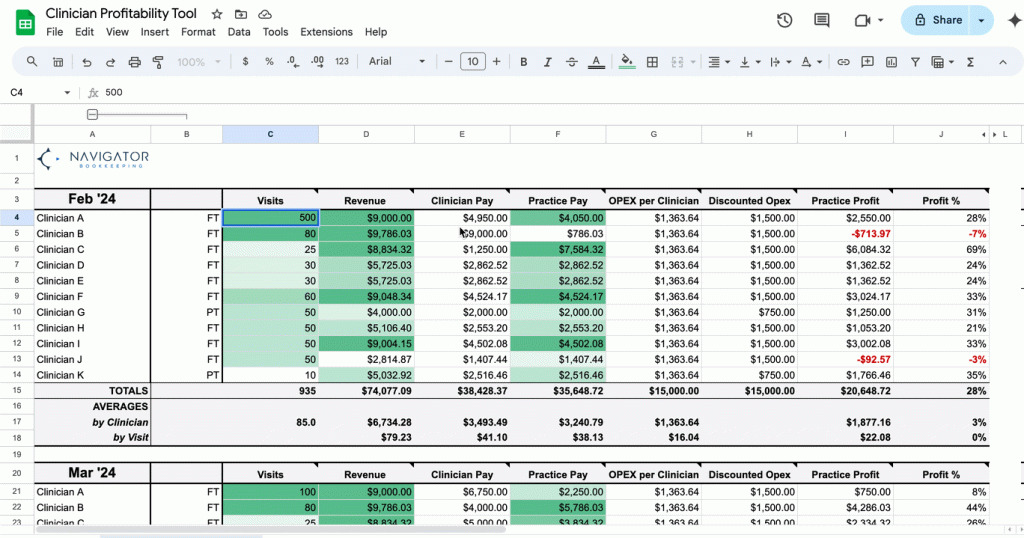
The best way to figure out your specific number? Run it through a compensation tool that accounts for your actual revenue, clinician costs, and overhead.
We built one for exactly this purpose. Check out our free Clinician Profitability and Compensation Tool here — it lets you model out different pay scenarios so you can see the real impact before you commit.
Ultimately, deciding how much to pay yourself in private practice is one of the most important financial decisions you'll make as an owner.
Want Help Running Your Numbers?
If you're not a Navigator Bookkeeping partner yet and want a second set of eyes on your finances, we offer a free 30-minute consultation where we'll help you figure out exactly what you can afford to pay yourself — based on your actual numbers, not guesswork.